
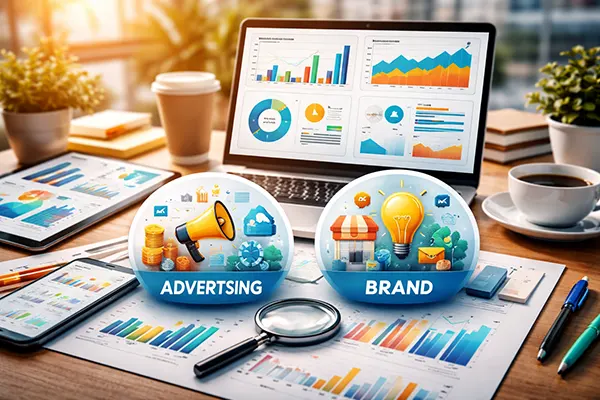
How to Distinguish Brand Demand from Advertising Results in Marketing
Many companies misinterpret their marketing performance because they do not separate brand demand from the real impact of advertising campaigns. When a user searches for a company name or visits a website directly, this behaviour may look like the result of advertising activity. In reality, such traffic often comes from brand recognition that was built over months or years. Understanding this difference is essential for marketers who want to evaluate campaigns objectively and allocate budgets efficiently.
Why Brand Demand and Advertising Performance Are Often Confused
Brand demand refers to traffic and conversions generated by people who already know the company or product. These users search for a brand name, visit the website directly, or click on familiar links in search results. Their decision to engage with the brand is not always caused by a current advertising campaign but by previous exposure, reputation, recommendations, or long-term marketing activities.
Advertising performance, in contrast, measures the impact of specific marketing actions such as paid search campaigns, social media promotion, display advertising, or affiliate partnerships. The purpose of advertising is usually to attract new audiences, stimulate demand, and convert users who might not yet be familiar with the brand.
Problems appear when both sources of traffic are counted together. For example, branded search queries may increase after launching a campaign, but this does not necessarily mean the advertisement created the demand. In many situations, the campaign simply captured users who already intended to find the brand.
Typical Indicators of Brand Demand in Analytics
One of the clearest indicators of brand demand is the presence of branded keywords in search traffic. Queries that contain the company name, product name, or unique brand terms usually signal existing awareness. Tools such as Google Search Console or analytics dashboards make it possible to analyse the share of branded versus non-branded queries.
Direct traffic is another common signal. When users type a domain name into the browser or use saved bookmarks, they demonstrate familiarity with the brand. Although some direct traffic may include technical attribution errors, a stable level of direct visits often reflects brand strength.
Returning visitors also provide valuable evidence of brand demand. If a large proportion of website users come back repeatedly, the business is benefiting from accumulated brand recognition rather than solely from ongoing advertising campaigns.
Methods Marketers Use to Separate Advertising Impact
Modern marketing analytics relies on several techniques to measure the real contribution of advertising. One of the most widely used methods is separating branded and non-branded search campaigns. Non-branded keywords attract users who are looking for solutions rather than specific brands, which makes them a better indicator of advertising effectiveness.
Incrementality testing has also become a standard practice. In this approach, marketers run controlled experiments where advertising is paused in selected regions or audiences. If conversions remain stable during the pause, it indicates that the campaign was mostly capturing existing demand instead of generating new interest.
Another technique involves analysing assisted conversions and multi-touch attribution models. By examining the full customer journey, marketers can determine whether advertising introduced a user to the brand or simply appeared near the end of an already established decision process.
The Role of Data Attribution Models
Attribution models help marketers understand how different channels contribute to conversions. Traditional last-click attribution often exaggerates the value of branded search campaigns because users frequently perform a branded query immediately before completing a purchase.
More advanced models, such as data-driven attribution or position-based attribution, distribute credit across multiple touchpoints. This approach highlights the importance of earlier interactions such as display advertising, social media exposure, or content marketing.
Using several attribution perspectives allows marketing teams to compare results and identify patterns. If branded search constantly receives the majority of credit, it may signal that the model needs adjustment or that brand demand is dominating the conversion path.

Practical Strategies for Evaluating Marketing Effectiveness
Separating brand demand from advertising impact requires a structured measurement framework. A useful first step is maintaining independent tracking for branded and non-branded campaigns. This segmentation provides clearer visibility into how new audiences discover the business.
Marketers should also monitor brand awareness metrics over time. Indicators such as branded search volume, direct traffic growth, and brand mentions in social media can reveal how recognition evolves independently from short-term advertising campaigns.
Budget allocation decisions become more accurate when these metrics are analysed together. If branded demand grows while non-branded acquisition remains stable, the company may benefit more from brand-building strategies than from increasing performance advertising budgets.
Building Long-Term Brand Measurement Systems
Long-term measurement requires consistent data collection. Marketing teams often combine web analytics, advertising dashboards, and brand research studies to obtain a complete picture of customer behaviour.
Regular brand surveys can provide insights that are not visible in digital analytics. Questions about brand recognition, preference, and recall help identify whether awareness is increasing because of marketing activity or because of external factors such as word-of-mouth recommendations.
By combining behavioural data with research insights, businesses can make more reliable conclusions about their marketing effectiveness. Distinguishing brand demand from advertising results allows companies to invest in strategies that genuinely expand their audience rather than simply capturing traffic that already existed.
Best News
-
 SMM Automation: Chatbots, Messaging Tools ...
Social media management in 2025 is increasingly shaped by automation technologies that support communication speed, service …
-
 Vibe Marketing: Creating Campaigns Driven ...
Modern marketing is no longer defined solely by data-driven decisions. While statistics and analytics remain vital, …
-
 How to create a successful brand?
Brand success is an important indicator. Thanks to it, you can stand out from the competition …
-
 What is copywriting?
Copywriting is now one of the stable sources of additional or permanent income. However, not everyone …
-
 What is marketing?
Now more and more people get information from the Internet. Newspapers and televisions have been replaced …
-
 How to choose a logo?
The logo is an important symbol of any brand. It is designed to make the company …